Canopy: An Edge-First AI Pattern for Models That Know What They Don't Know
Most edge-AI architectures make the same quiet mistake. They put a small model on the device, add a confidence threshold, and route the low-confidence cases up to a bigger model in the cloud. It sounds reasonable. It fails in exactly the place you cannot afford it to.
The problem is that small models are most confident when they are most wrong. Hand a compact on-device model an input unlike anything it was trained on, and it does not return a low score and politely defer. It returns a fluent, confident, wrong answer. Confidence measures how sharp the model's guess is, not whether the question was inside its competence at all. So "route on confidence" routes away the easy uncertain cases and keeps the dangerous confident-but-wrong ones on the device.
The fix is to change what the edge is allowed to assume. An edge model should not answer because it feels sure. It should answer because the question lands inside what it actually knows, and escalate everything else. We call the resulting pattern Canopy.
The shape
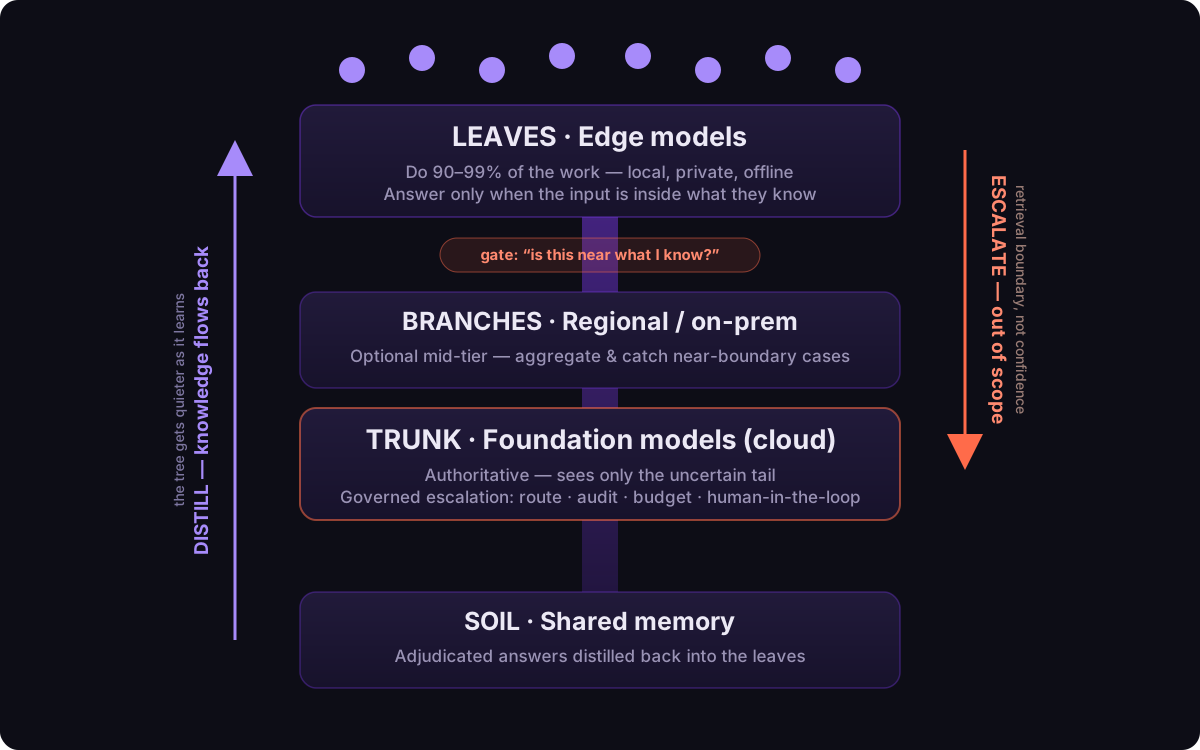
Canopy is a tree, and work only climbs it when it has to.
Leaves are the models on the devices. Small, quantized, specialized to one job, running locally. They are meant to handle the overwhelming majority of traffic — 90 to 99 percent — with no network, low latency, and no data leaving the device.
Branches are an optional middle tier: a mid-sized model on a local server or gateway. They catch escalations that are uncertain but still latency- or privacy-sensitive, and they can aggregate signal across many leaves. Plenty of deployments skip this tier.
The trunk and roots are the foundation models in the cloud. Large, authoritative, expensive — and they only ever see the uncertain tail. There is more than one, on purpose: different providers for different jobs, with failover between them.
The soil is a shared memory store. Every answer the trunk adjudicates is written back and distilled down into the leaves, so the boundary of what the edge can handle grows outward over time.
Work flows up only when a leaf admits it is out of its depth. Knowledge flows back down so the leaf has to admit it less often next time.
The hard part: knowing the boundary
Everything in Canopy depends on one decision made on the device: is this input inside what I know, or not? Get that decision right and the rest is plumbing. Get it wrong and you either flood the cloud with escalations or ship hallucinations. Here is how to make it well, strongest signal first.
Retrieval boundary. Give each leaf a small local index of what it was trained and grounded on. Embed the incoming input and measure its distance to the nearest thing in that index. If the input sits far from anything the model actually knows, it is out of scope — escalate. This is the signal that matters most, because it checks whether the question is near the model's knowledge, not whether the model feels good about its answer. It is the direct antidote to assuming.
Calibrated abstention. Train the leaf with an explicit "I am not sure" option and calibrate its thresholds so that abstaining is statistically honest rather than a vibe. A model that is allowed to say "I don't know" is worth more than one that never does.
Self-consistency. Sample the leaf two or three times. If the answers disagree, the model is guessing. Cheap, and it catches a surprising amount.
A local verifier. Run a tiny critic that scores the leaf's own answer. Verifying is cheaper than generating, so this is affordable on-device, and a low score is a clean escalation trigger.
Policy triggers. Some categories escalate no matter how confident the leaf is: safety-critical actions, regulated decisions, anything irreversible or high-value. Confidence does not get a vote there. This is the governance overlay, and in the real world it is not optional.
One rule ties these together: the gate has to be cheaper than the cloud call it is deciding about. If figuring out whether to escalate costs as much as escalating, you have gained nothing. Retrieval distance and a small verifier are cheap. That is why they carry the load.
What the cloud is actually for
When a leaf escalates, the foundation model does more than answer. It adjudicates and explains. That answer, the question that prompted it, and the reasoning behind it get written to the soil and periodically distilled back into the leaf. The next time a similar question arrives, the leaf handles it itself.
The consequence is that escalation rate should fall over time. If your edge fleet is escalating the same class of question month after month, the feedback loop is broken. A healthy Canopy gets quieter as it matures.
Why the economics invert
The default posture in AI today is to send everything to a large cloud model. That pays foundation-model prices on 100 percent of traffic. Canopy pays near-zero edge prices on the 90-plus percent the leaves handle, and foundation-model prices only on the uncertain tail — which is precisely the slice where a large model earns its cost. You do not pay premium rates for a frontier model to answer the same easy question a million times.
Latency, privacy, and offline resilience come along for free, because they are properties of doing the work locally rather than features you bolt on. The device answers instantly, the data stays put, and the system keeps working when the link drops.
The failures to design against
Over-escalation. If everything looks uncertain, you have rebuilt the cloud with extra steps and a bigger bill. Watch escalation rate as a live metric and calibrate the gate against it.
Under-escalation. If the leaf is overconfident on inputs it has never seen, hallucinations slip through. This is the failure that motivated the whole pattern, and it is why the retrieval boundary leads and raw confidence does not.
A trunk you cannot reach. On real edge the network is not guaranteed. When the cloud is unreachable, the leaf must degrade safely — abstain, queue the escalation for later, or fall back to a conservative predefined action. It must never quietly guess because the cloud is down. An edge system that hallucinates the moment it loses signal is worse than one that says "I cannot answer that right now."
Drift. The world moves and the leaf's sense of what it knows goes stale. The soil-to-leaf loop plus periodic recalibration is what keeps the boundary honest.
Where a control plane fits
Escalation is not just a technical hop. It is a governed event, and treating it that way is what makes Canopy safe to run at scale.
Every escalation should route to the right foundation model — the best or cheapest for the job, with failover across providers. Every one should land in a single audit ledger, so you can answer later exactly which inputs your fleet could not handle and what the cloud decided. Every one should be metered against a budget, so a misconfigured gate cannot quietly run up a bill. And the highest-stakes escalations should pass through a human-in-the-loop step before anything acts on them.
That is a control plane, pointed at the edge. The leaves and the soil are the new pieces you build for a Canopy deployment. The routing, the audit ledger, the budgets, and the approval queue already exist — that is the layer Bonito is. The trunk of the tree becomes a governed escalation router, and the fleet below it stays legible instead of being a thousand black boxes making silent decisions.
The one idea to keep
An edge model that knows its own boundary beats a bigger one that does not. The trick is defining that boundary by what the model can retrieve from what it knows, not by how confident it happens to feel — and then treating every step past the boundary as a governed escalation, not a guess.
